Sunday, May 8, 2011

Volcker warns of danger from U.S. deficits


WASHINGTON | 
Fri May 6, 2011 10:15pm EDT
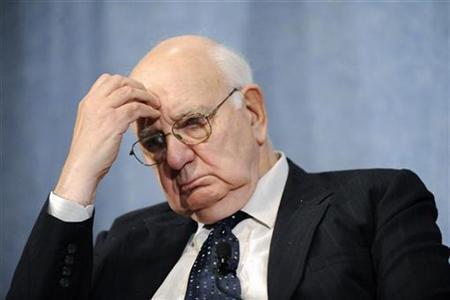
WASHINGTON (Reuters) – Former Federal Reserve Chairman Paul Volcker warned on Friday that trillion-dollar deficits posed a threat to the stability of the U.S. economy and the dollar, and said he is frustrated by the gridlock in Washington.
Speaking before the World Affairs Council of Oregon, Volcker said that “prolonging trillion dollar deficits can’t be a reality” and that the United States is on course to have its public debt exceed the size of its gross domestic product.
“One way or another, we do have to return to a balanced budget,” he said in prepared remarks.
Volcker’s speech came on the same day that the Congressional Budget Office said the U.S. budget deficit had totaled $871 billion for the first seven months of the year, which is significantly above the previous year’s pace. On Thursday, Vice President Joe Biden led a bipartisan meeting in an effort to strike a deal with Republicans on cutting the growing federal deficit and averting a default.
They face an August 2 deadline to raise the country’s $14.3 trillion debt limit.
Volcker, who stepped down early this year as the chairman of President Barack Obama’s Economic Recovery Advisory Board, said he was concerned about how the U.S. consumes and borrows “to the point that China, Japan and other foreign countries hold more than 5 trillion dollars of U.S. government obligations.”
“Consider that statistic in the light of prospects for continuing deficits, doubts about future inflation and the international stability of the dollar,” he said, noting that the U.S. is running out of time to fix things.
In order to address the deficit, Volcker said he agrees lawmakers need to tackle discretionary spending, an area that could help the U.S. save $300 billion from present projections by 2020. But that alone, he said, will not be enough to address the trillion dollar deficits.
“I will put the point bluntly,” he said. “It is simply unrealistic and irresponsible to believe budgetary balance can be achieved without higher revenues relative to GDP. We won’t generate those higher revenues without tax reform.
Separately, Volcker also discussed his views on the progress made so far on the Dodd-Frank Wall Street overhaul legislation and other efforts around the world to bolster regulation of the financial markets.
Volcker was the driving force behind a pillar of the Dodd-Frank law known as the Volcker rule, which cracks down on proprietary trading by big banks. Although he no longer has a formal advisory role in the administration, he still visits the White House on occasion.
In particular, he said he was concerned about a failure to properly address certain key areas including credit-rating agencies, accounting issues and money market funds — an issue the Securities and Exchange Commission plans to explore in a roundtable discussion next week.
“Taken all together, my personal grade on financial reform is incomplete,” he said, noting that it is even more lacking abroad than in the U.S. “I do not equate incomplete with out of time, but I fear that momentum in the reform effort is waning.”
source : Original Source

Saturday, May 7, 2011

China Buying Silver Overnight


China Buying Silver Overnight, Prudent Money Holding and Accumulating Bullion on Dip
Gold and silver are tentatively higher after their 2% and 8% falls yesterday. In silver, speculators on the COMEX continue to liquidate en masse after margin was increased a massive 84% and various stop loss levels are hit, leading to further falls in the futures market.
GoldCore
Cross Currency Rates

Absolutely nothing has changed regarding the fundamentals driving the gold and silver markets and this will likely be another correction in gold and another sharp correction in silver.
Gold and silver’s rise is likely to continue until we return to a world of healthy economic growth, low inflation and positive real interest rates.
GoldCore
Gold in US Dollars - Bloomberg Adjusted for Inflation 1971 to 2011 (Monthly)

It is important to put the falls in gold and particularly silver in context and as ever focus on the long term. The long term inflation-adjusted charts put the gold correction and silver crash (above and below) in perspective and show both as being buying opportunities again. Although buyers should consider dollar cost averaging into position in order to mitigate any further price weakness.
With macroeconomic, monetary and geopolitical risks remaining high – including the threat of terrorism and war – safe haven demand from investors, pension funds and central banks is likely to continue.
The usual gold and silver bubble callers are out in force once again and it is interesting how there appears to be more coverage of gold and particularly silver now than there was with prices rising in 2010 and early 2011.
GoldCore
Silver in US Dollars - Bloomberg Adjusted for Inflation 1971 to 2011 (Monthly)

Indeed, mere rumours that Soros may have sold some of his gold and silver holdings led to massive media coverage.
The fact that John Paulson and a number of other increasingly respected hedge fund managers still own massive gold positions and are not selling did not receive as much coverage as the rumours of Soros selling some of his gold.
John Paulson told investors at a breakfast on Tuesday that he expects gold to hit $2,500/oz to $4,000/oz in the next three to five years.
Also, the massive gold accumulation by Mexico, Russia and Thailand was barely reported in the non-specialist financial press, nor was reported the news regarding Portugal being urged to sell its gold by senior German lawmakers.
Silver’s sell off has been vicious but value buyers continue to accumulate silver bullion. Jim Rogers, who arguably has a better track record than Soros in recent years, remains bullish on gold and silver and told CNBC, “if it goes down I hope I’m smart enough to buy more silver."
Other widely followed and respected investors with expertise on gold and silver such as Peter Grandich and Jim Sinclair are also relaxed about the falls and remain bullish on gold and silver due to the continuing strong fundamentals.
Also, there are reports this morning from the Wall Street Journal and Mitsui that there was decent buying of silver from China at these price levels overnight.
credit : GoldSilver.com

silver drop as 2008


Silver, Gold Futures Dropping as Soros Reported to Have Sold

george soros
bar silver

Silver futures fell, heading for the biggest three-day drop since 2008, and gold also retreated amid a report Soros Fund Management LLC sold precious-metal assets.
Soros Fund Management sold some holdings because of a reduced risk of deflation, according to the Wall Street Journal, which cited unidentified people close to the matter. Michael Vachon, a spokesman for Soros, declined to comment. The fund held shares in the SPDR Gold Trust, the biggest exchange-traded product backed by gold, and the iShares Gold Trust (IAU) at the end of 2010, U.S. Securities and Exchange Commission filings show.
Silver futures fell as much as 5 percent to $40.465 an ounce on the Comex exchange in New York. The contract was at $41.72 as of 6 a.m. local time, for a three-day decline of 14 percent. Margin requirements were raised 38 percent in since April 26. Gold futures retreated 0.2 percent to $1,537 an ounce.
“Some small, speculative players had to trim their silver positions as they couldn’t afford to pay for such margins,” said Jerome Berset, a portfolio manager at Palaedino Asset Management SA in Geneva, which has 1 billion euros ($1.49 billion) in assets and has maintained holdings in gold and silver. “For long-term players with fundamental views, this may be a good time to get in for both silver and gold.”
The decade-long bull market in gold and silver attracted fund managers from Soros to John Paulson and spurred central banks to add to their reserves for the first time in a generation. Investors in exchange-traded products backed by gold accumulated more metal than all but four central banks, while silver holdings are equal to more than eight months of global mine supply, according to data compiled by Bloomberg.

Gold Reaches Record

Gold reached a record $1,577.57 an ounce on May 2, a sixfold gain since prices bottomed in August 1999. Spot silver rose to an all-time high of $49.79 an ounce on April 25, a 12- fold advance from the low of $4.04 reached in 2001.
The Soros fund held 4.72 million SPDR Gold Trust shares as of Dec. 31, equal to about 460,000 ounces, an SEC filing on Feb. 14 showed. It also owned 5 million shares in the iShares Gold Trust, equal to about 48,800 ounces. The firm had 19,900 shares in Pan American Silver Corp., a Vancouver-based company mining the metal in MexicoPeru, Argentina and Bolivia. There were also stakes in Barrick Gold Corp. (ABX)Kinross Gold Corp. (K) and Novagold Resources Inc. (NG), the filing shows.
Soros described gold at the World Economic Forum’s meeting in Davos, Switzerland, in January last year as “the ultimate asset bubble.” In a Nov. 15 speech in Toronto the 80-year-old said conditions for the metal to keep rising were “pretty ideal” and at this year’s Davos forum he said the boom in commodities may last “a couple of years” longer.

Paulson Holding

Paulson & Co.’s holding was 31.5 million shares in SPDR Gold at the end of December, an SEC filing shows.
Passport Capital Management LLC also sold some gold holdings to lock in profit, the Wall Street Journal reported, citing a person close to the fund. Passport Capital held 3 million put options onSPDR Gold shares (GLD) and 28,100 shares in Barrick Gold as of Dec. 31, according an SEC filing. Two phone calls outside of normal office hours to John Burbank, founder of Passport Capital, weren’t answered.
CME Group Ltd., the owner of the Comex exchange, said this week the minimum amount of cash that must be deposited when borrowing from brokers to trade silver futures will rise to $16,200 per contract at the close of business yesterday from $14,513. A year ago, the margin was $4,250.
“Silver is often the lead indicator for changes in trends, or at least for corrections,” David Wilson, an analyst at Societe Generale SA, wrote in a note. After futures rallied to a record $50.35 an ounce in January 1980, prices dropped 78 percent in four months.
From the start of this year to the end of April, silver futures rallied 57 percent and were the best performer among the 24 raw materials tracked by the Standard & Poor’s GSCI Index.
Silver assets held in exchange traded products fell 1.1 percent to 15,169.80 metric tons yesterday, while gold holdings stood little changed at 2,069.78 tons, according to data compiled by Bloomberg.
credit : www.bloomberg.com

MICHAEL MALONEY- SILVER EXPERT AND SILVER ADVISOR FOR RK


6 Charts Which Prove That Central Banks All Over The Globe Are Recklessly Printing Money


By Michael Snyder - BLN Contributing Writer

If the U.S. dollar is being devalued so rapidly, then why does it sometimes increase in value against other global currencies?  Well, it is because everybody is recklessly printing money now.  The 6 charts which you are about to see below prove this.  The truth is that it is not just the U.S. Federal Reserve which has been printing money like there is no tomorrow.  Out of control money printing has also been happening in the UK, in the EU, in Japan, in China and in India.  There are times when one particular global currency will fall faster than the others, but the reality is that they are all being rapidly devalued.  Unfortunately, this is a recipe for a global economic nightmare.
Right now you can almost smell the panic as it rises in global financial markets.  Investors all over the world are racing to get out of paper and to get into hard assets.  Just about anything that is “real” and “tangible” is hot right now.  Gold hit a record high last year and it is on the rise again.  In fact, it just hit A New Five-Week High.  Demand for silver is becoming absolutely ridiculous right now.  Oil is marching up towards $100 a barrel again.  Agricultural commodities have exploded in price over the past year.  Many investors are even gobbling up art and other collectibles.
Paper money is no longer considered to be safe.  All over the globe investors are watching all of the reckless money printing that has been going on and they are becoming alarmed.  An increasing number of investors and financial institutions are putting their wealth into hard assets that are real and tangible in an effort to preserve their wealth.
The other day, a reader of this column named James sent me some charts that he had put together.  I thought they were so good that I asked him if I could include them in an article.  These charts show how central banks all over the globe have been recklessly printing money.  Over the last 30 years virtually the entire world has developed a great love affair with fiat currency….
So is everyone printing money?
The U.S. is printing lots of money…..
6 Charts Which Prove That Central Banks All Over The Globe Are Recklessly Printing Money  Chart1
The Bank of England is printing lots of money…..
6 Charts Which Prove That Central Banks All Over The Globe Are Recklessly Printing Money  Chart2
The EU is printing lots of money….
6 Charts Which Prove That Central Banks All Over The Globe Are Recklessly Printing Money  Chart3
Source: The ECB
Japan is printing lots of money…..
6 Charts Which Prove That Central Banks All Over The Globe Are Recklessly Printing Money  Chart4
China is printing lots of money…..
6 Charts Which Prove That Central Banks All Over The Globe Are Recklessly Printing Money  Chart5
India is printing lots of money…..
6 Charts Which Prove That Central Banks All Over The Globe Are Recklessly Printing Money  Chart6
DETAIL MORE : http://goldsilver.com

Next in line?


The smartest way to avoid queuesEPA

NOT so long ago one of the stock photographs used to illustrate articles about the East-Asian economic boom would show a long queue of ordinary people waiting to buy shares in a new public offering. These days, the people lined up outside financial institutions in South-East Asia are more likely trying to get their money out. Thailand, the Philippines and Indonesia have all seen runs on banks or finance companies. Last month, Malaysia was added to the list, when customers of its biggest finance company, MBf, panicked at untrue rumours that the chief executive, Loy Hean Hong, was seriously ill, or even dead.
After the debacle in Thailand, where two-thirds of the country’s finance companies have been closed down, regional jitters are understandable. In the event, the run in Malaysia was handled with aplomb: the central bank issued a reassuring statement, andMBf kept branches open late and moved cash swiftly round the country. But Malaysian officials, who have boasted that the country’s economic “fundamentals” are healthier, and its banking system sounder, than those in Thailand can no longer be so confident.
The 21 domestically owned Malaysian banks are not swamped in the sea of bad debt that engulfed the Thais. In the property sector, Malaysia has, by most estimates, done far less overbuilding of offices, shopping malls and expensive flats. Foreign debt is less than half Thailand’s $90 billion. While Thailand’s economy will hardly grow at all this year, Malaysia’s government expects to achieve more than 7% growth this year, and more than 6% in 1998.
MORE DETAIL : www.economist.com

Silver FALLS


Silver Investors Dump Bets After Exchange Boosts Margins 84%


The biggest slump for silver since 1983 may not be over as the Comex exchange in New York makes it 84 percent more expensive for speculators to trade the metal, triggering an exit by investors.
The minimum amount of cash that must be deposited when borrowing from brokers to open new positions will rise to $21,600 per contract after May 9, CME Group Ltd., Comex’s owner, said yesterday. That’s up from $11,745 two weeks ago. Open interest in futures has tumbled about 15 percent since the exchange began raising margin requirements on April 25.
Prices may drop an additional 14 percent to $34 an ounce by the end of next week from yesterday’s closing price, according to the average forecast in a Bloomberg News survey of six analysts. Silver has more than doubled in the past year as record-low U.S. borrowing costs and a slumping dollar prompted investors to buy precious metals as alternative assets.
“You’re talking about a very volatile market, a very significant run-up in a very short period of time,” said Michael Cuggino, who helps manage $12 billion at Permanent Portfolio in San Francisco. “It went too high too fast, and exacerbating it on the downside is the increased margin requirements.”
As of April 29, the metal had soared 57 percent in 2011, the most among the 19 commodities tracked by the Thomson Reuters/Jefferies CRB Index. In the past four sessions, silver plunged 25 percent, the most since February 1983. The slump trimmed this year’s advance to 17 percent, trailing gains by gasoline, coffee and gasoil.

‘Frothy Market’

“If you have to put up that much more margin, many people simply say ‘no, I won’t do it,’ so they liquidate,” said Dennis Gartman, an economist and the editor of the Suffolk, Virginia- based Gartman Letter. “It got a bit frothy, and frothy markets need to correct.”
CME raised margins after “unprecedented high levels of volatility,” Harriet Hunnable, the managing director of metals products, said in a telephone interview from the company’s headquarters in Chicago. Silver’s 10-day historical volatility jumped to 81.19 today, the highest since March 2009. The exchange has announced five margin increases in the past two weeks.
“When markets become highly volatile, and we can see the market anticipates further volatility, then it is highly likely that we will change the amount we require,” Hunnable said. “The exchange increases margins to manage the risk people face.”

Margins Increase

Before the increases, margins were about 5 percent of the value of a futures contract, which is for 5,000 ounces. After the plunge in prices, the cost after May 9 would be about 12 percent of a contract, using today’s settlement.
Silver “went up much too fast, and if it continues to go up, that’s disaster,” said Jim Rogers, the chairman of Singapore-based Rogers Holdings, who predicted the start of the global commodities rally in 1999. “I’m very happy it’s coming down nicely. I hope it comes down some more so I can buy some more. Markets are always correcting.”
The metal may reach $45 in the third quarter, said Ralph Preston, a principal at Heritage West Financial Inc., a San Diego company that specializes in futures trading. “At this point, I see some serious long liquidation and profit taking, but not an end to the historic 2011 rally.”

Rally Outlook

The rally won’t stop “until the Federal Reserve begins to aggressively hike interest rates, the Middle East simmers down, and the U.S. Commodity Futures Trading Commission concludes its multiyear investigation into supposed market manipulation,” Preston said.
Silver futures for July delivery fell $3.148, or 8 percent, to close at $36.24 on the Comex.

credit to : bloomberg.com